Monday, July 26, 2010
Alignment as theme
I've been thinking about alignment as a thematic dichotomy. Each campaign could have its own thematic alignment scheme. OD&D is Lawful/Chaotic. Other possibilities might be Civilized/Barbarous (Conan), Mundane/Fey (Strange & Norrell), or New Religion/Old Religion (Arthur).
Carcosa is interesting in that it repurposes OD&D's general Lawful/Chaotic alignment scheme by making it a specific, thematic element of the game: lawful characters oppose releasing Lovecraftian Old Ones from imprisonment, while chaotic characters seek to aid and serve the Great Old Ones.

Sunday, July 25, 2010
Monster INT is a helpful stat
Working with OD&D sources, one of the things I miss is an intelligence stat for monsters. It's one of the few things which causes me to reach for my 1e Monster Manual or OSRIC.
As a DM, I've always found those intelligence scores to be important when controlling monsters. Maybe this is one of those things a 0e DM has to decide for himself—my stirges are cunningly intelligent, or the traumatic death of wights have destroyed their higher faculties in my game. That's flavor, I suppose, and it messes with player expectations (which could be good or bad).
Saturday, July 24, 2010
Otherworld Miniatures
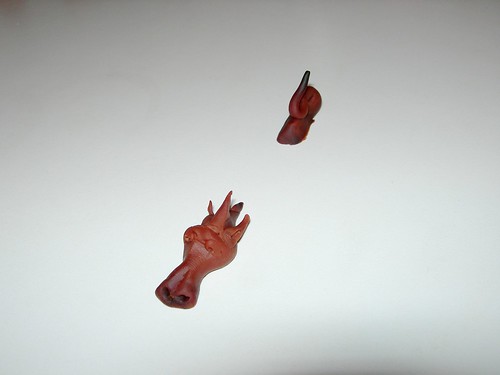
I just discovered Otherworld Miniatures. I've been meaning to find some classic pig-faced orcs, and their bugbears are pretty great too: 

Friday, July 23, 2010
Angry Villager Rule
I came across this Angry Villager Rule in The Underword & Wilderness Adventures:
Whenever the referee finds that some player has committed an unforgivable outrage this rule can be invoked to harass the offender into line. Within the realm of angry villagers are thieves from the 'thieves' quarter'..."What a great urbane adventure module could be made from the material in Fritz Lang's M! (Don't read the last two paragraphs of that linked essay if you haven't seen M yet. And you should see it.)
Thursday, July 22, 2010
Do you employ hirelings?
When I first started reading about old-school gaming, what struck me was how little my adolescent Basic and 1e games resembled the Old-School Style. Much of the difference, I'm starting to suspect, was that we ignored rules that sounded "boring" without trying them. We didn't use encumbrance, for example, or keep track of light sources. In retrospection, resource management was a huge element of the game—an element we ignored perhaps to our detriment.
So, I've been picking through my memory and reading old rulebooks, making a list of mechanics I've never actually played. One of those is the use of hirelings. In Men & Magic, it says:
"Charisma is a combination of appearance, personality, and so forth. Its primary function is to determine how many hirelings of unusual nature a character can attract. This is not to say that he cannot hire men-at-arms and employ mercenaries, but the charisma function will affect loyalty of even these men. Players will, in all probability, seek to hire Fighting-Men, Magic-Users, and/or Clerics in order to strengthen their roles in the campaign. A player-character can employ only as many as indicated by his charisma score"If the primary function of charisma is to determine the number and loyalty of hirelings, and charisma itself was important enough to make it one of the six attributes, then hirelings must be an important part of the game, right? On the other hand, M&M later speaks of
"acquiring a regular entourage of various character types, monsters, and an army of some form."That makes me question whether hirelings were in fact a vestigial hold-over from Chainmail, and little-used in actual D&D play. I'd love to hear anecdotal evidence one way or the other. Did you use hirelings in your games back in the day? Do you use them now?
Tuesday, July 20, 2010
Part 1: The Malevolent Mystery of Marshburg
On Sunday afternoon I ran my first 4e game—part of an adventure I call The Malevolent Mystery of Marshburg. The session went pretty well, particularly in light of how long it's been since I've written an adventure or DM'd, and that none of us have played 4e. My players even asked if we could continue the adventure tomorrow after work, which was a nice complement.
In five hours we gathered rumors in town, found the dungeon site, explored a half dozen rooms, and completed two major encounters. Kobolds were defeated. A trap was disarmed. One PC was reduced to zero hit points, but recovered. All but one of the Goblins were killed, and that one managed to escape by spiking a door shut between him and the PC's. (If the players can do, why not the monsters?)
I tried to run certain aspects of the game in "classic mode". The trap was disarmed through dialogue between me and the players rather than a simple role, for example.
4e feels more like a tactical miniatures game than any previous edition, but that's all I'm prepared to say until we give the game a fair run-through in a number of sessions.
Monday, July 19, 2010
Subscribe to:
Posts (Atom)